
Location based marketing defined
Location based marketing is any marketing that changes what a person sees according to where they are. Its working core is location-based advertising, which combines mobile advertising with location-based services to find a consumer’s location and send suitable ads. A location-based service is software that uses geographic data to provide information or services.
That definition covers a wide range of tools. A weather app, a store finder and a ride service are all location-based services. Each one knows where a phone is and can show something useful for that spot.
Marketing builds on that knowledge. A retailer might send a promotion to people near its store. A restaurant app might show a time-limited offer to someone browsing nearby.
The field also has a direction. Some messages are sent to people by the business, and some appear when people look for something themselves. The next section explains why that difference matters.
How location data turns into a local message
Location based marketing works in three moves. A device works out where it is, and an app or ad system matches that place to a campaign. The person then receives a message suited to the spot.
Each move depends on the person’s device, the app’s permissions and the rules that govern the data.
Finding the device
Devices can be located by satellite (GPS), cell towers, Assisted GPS, Wi-Fi, Bluetooth Low Energy, NFC or IP address. Assisted GPS speeds up a satellite fix with help from the mobile network. Bluetooth Low Energy is a short-range radio standard that small beacons use to signal nearby phones.
Each source covers a different distance. Satellites and cell towers place a device in a neighborhood or town. Bluetooth and NFC work within a room or at arm’s length.
Push and pull
Push location ads are started by the advertiser. Pull ads appear when users search for something themselves. The two forms reach people in very different moods.
Push ads can be opt-out or opt-in. Opt-out messages keep arriving until the user stops them, and that is the more common form. Opt-in messages arrive only when the user has chosen what to receive.
A pull ad responds to a request. One example is a New York traveler who finds a nearby restaurant in an app and gets a time-limited appetizer offer. The person asked for something nearby, and the offer met that request.
Proximity marketing
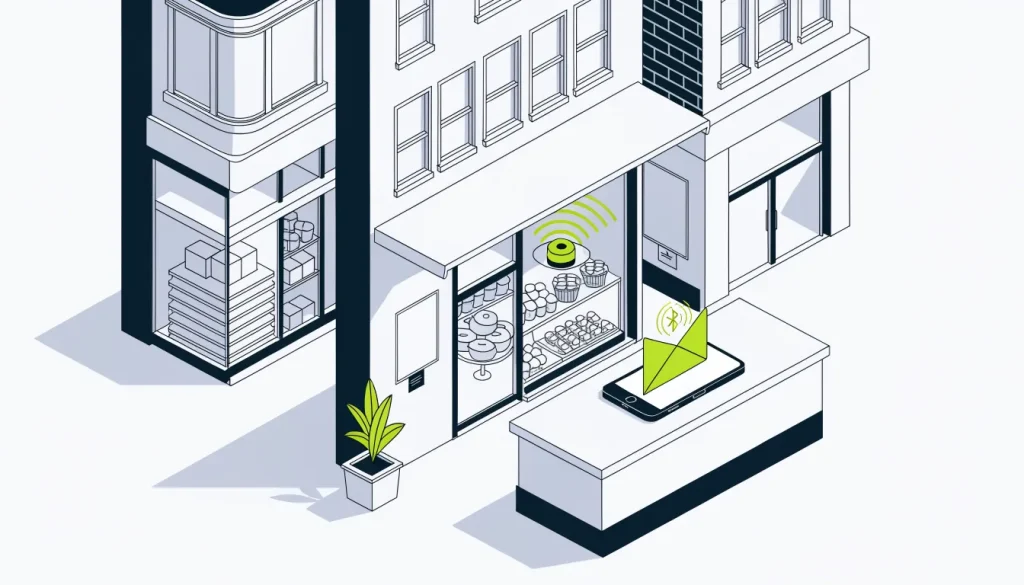
Proximity marketing is the localized wireless delivery of ads tied to a place. It uses Bluetooth, Wi-Fi, NFC or cell broadcast. The range is short, so it suits stores, malls, transit stations and venues.
The forms differ widely, and Part 1 of this series sets out the types of location marketing in more detail.
Main forms of location marketing compared
Location marketing takes a handful of main forms, set apart by who starts the message and how close the person must be. The table compares them on reach and on the technology each relies on. The forms can overlap in a single campaign.
| Form | Who starts it | Range | Usual technology |
|---|---|---|---|
| Push location ads | The advertiser | Area around a place | GPS, cell towers or Wi-Fi |
| Pull location ads | The user, by searching | Wherever the user is | App location and search |
| Proximity messages | The venue or advertiser | A room or storefront | Bluetooth, Wi-Fi or cell broadcast |
| NFC smart posters | The user, by tapping | Arm’s length | NFC tags |
| Mobile coupons | The retailer | Near the store | SMS and app alerts |
NFC smart posters show how short the range can be. They work when a phone is held close to a tag. Clear Channel UK fitted more than 25,000 posters with NFC tags.
Coverage differs inside venues. Wi-Fi access points detect only about 10–20% of visitors. Dedicated antennas reach about 60–70%.
Mobile coupons are a classic example of the push form. Retailers send promotions, often by SMS, to customers near their stores.
The forms can be combined. A shopping center might run push ads to phones in the surrounding area, then use proximity messages once visitors are inside. A poster with an NFC tag can hand off to an app that offers pull results nearby.
Each added form raises the consent question again. A person who agreed to one kind of message has not agreed to every kind.
What location marketing means for a local business
For a local business, location marketing is a way to reach people when they are near enough to visit. It can be as simple as a coupon text or as involved as a campaign on a large ad platform. Success depends on consent, sensible expectations and a clear offer.
The platforms involved
Large ad platforms offer location features. Google Ads offers location targeting by country, area or radius. Meta supports address and radius targeting through its Marketing API.
Neighborhood networks do too. Nextdoor offers hyperlocal ad targeting by neighborhood, interests and behavior.
Paid ad formats on these platforms are the subject of a separate guide on location based advertising. It walks through the steps an owner follows to run a campaign.
Starting small
A small business does not need a large platform to begin. A text coupon list, built from customers who asked to join, is already location marketing when it targets people near the store. A tagged poster in a window can invite passersby to tap for an offer.
The offer matters more than the technology. A clear, time-limited reason to visit gives a nearby person something to act on. A vague message adds to the noise that people already ignore.
Consent comes first
Location data is sensitive, and regulators treat it that way. The FTC said InMarket’s consent prompts mentioned app features, such as rewards points, but not advertising use. Its final order of May 1, 2024 bans InMarket from selling or licensing precise location data.
FTC technologists advise using data only for the purpose it was collected for. They also advise getting meaningful consent, not consent tied only to app features. For marketing email, the FTC says the CAN-SPAM Act requires a clear way to opt out.
State law can apply too. Washington and New York have bans on geofencing around health care facilities in force. A business near a clinic or hospital should check those rules, and this guide is not legal advice.
The limits worth planning for
Reference sources list several drawbacks. Privacy concerns are one, and ads seen as spam are another. Users spend only 8 to 10 seconds on mobile ads.
There is also a fairness concern. A claim that suits one location may not be true in another, so national offers need local checks. A promise that cannot be met in every place can mislead.
Fair housing rules show how location choices can go wrong. HUD’s 2019 charge against Facebook centered on housing advertisers who could leave out neighborhoods drawn on a map. Choosing which areas to leave out can carry legal risk.
Misconceptions about location marketing
Four beliefs about location marketing tend to cause trouble. They concern consent, anonymity and what visit reports show. The corrections come from FTC findings, Google’s documentation and published research.
“A tap on ‘allow location’ means consent to ads.” The FTC rejected consent tied only to app features. Consent for advertising should be clear and specific.
“Location data without names is anonymous.” A 2013 MIT study found that four spatio-temporal points uniquely identified 95% of 1.5 million people. A spatio-temporal point is a place paired with a time.
“Store visit reports show which people came in.” Google Ads store visit conversions are anonymous, aggregated and modeled. They show estimated totals, not individuals.
“Any business can measure store visits.” Store visits need physical locations in a supported country, active location assets and enough clicks and foot traffic. Locations tied to sensitive topics such as religion or certain health issues are not eligible.
Frequently asked questions
Can you give me an example of location-based marketing?
A retailer sending a text coupon to customers near its store is a common example. Another is a restaurant app that shows a time-limited appetizer offer to a traveler browsing nearby places.
What are some examples of location-based services?
A location-based service is software that uses geographic data to provide information or services. Store finders, map apps and apps that show nearby restaurants are typical examples. Each one works out where a device is and responds to that place.
How do phones know where they are for location marketing?
Phones can be located by GPS, cell towers, Assisted GPS, Wi-Fi, Bluetooth Low Energy, NFC or IP address. Short-range methods such as Bluetooth and NFC suit messages inside a store or venue.
Do people have to opt in to location marketing?
Push ads can be opt-in or opt-out, and opt-out is the more common form. The FTC has stressed meaningful consent for advertising use, not consent tied only to app features.
Exploring the geomarketing hub
This guide opens the geomarketing hub’s coverage of location marketing. The hub also covers paid location ads, consent and privacy, and how store visits are measured. Every guide on the subject is listed under geomarketing explained.