
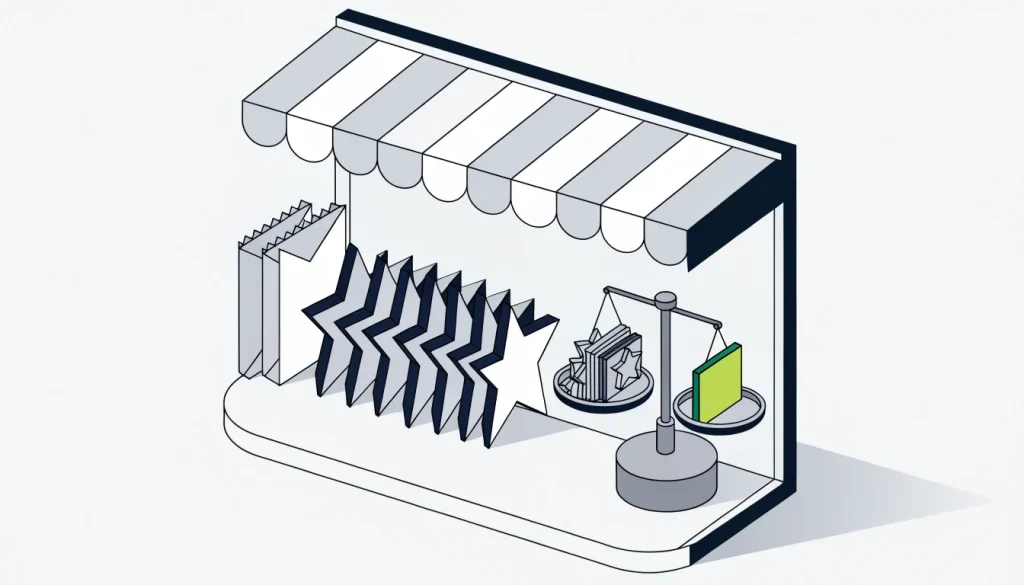
What is Trustpilot, in one answer
Trustpilot is an open review platform: consumers post reviews of businesses, and businesses manage their public profile. “Open” means a business cannot stop people from reviewing it. Anyone with a genuine experience can leave a review, with or without an invitation from the business.
Trustpilot was founded in Denmark in 2007. It is headquartered in Copenhagen. It listed on the London Stock Exchange in March 2021.
The platform runs a freemium model. A freemium model offers a basic service at no cost and charges for extra features. Claiming a profile is free.
What a Trustpilot review means
A Trustpilot review is a star rating and written comment about a genuine experience with a business. It can arrive through an invitation or on the reviewer’s own initiative. Trustpilot labels each review by how it arrived.
How reviews move through Trustpilot
Reviews move through Trustpilot in four stages: a reviewer writes, automated systems screen, the review is published with a label, and it feeds the TrustScore. The business can reply or flag it along the way. Each stage has its own rules.
Reviews come in two ways
A review can be organic, meaning the reviewer came to Trustpilot without being asked. It can also come through an invitation the business sent. Trustpilot labels reviews as organic, automated invitation or manual invitation.
Invitations come with a fairness rule. Every customer has to receive the same invitation process. Picking who gets asked is forbidden, and so is timing requests to reach only satisfied buyers.
Every review is screened
Every submitted review is screened by automated systems. The signals they check include where a review was sent from, the device used, location and timing. The mechanics of how Trustpilot collects reviews and shows them get their own part of this series.
Reviews feed the TrustScore
TrustScore is the overall star score on a Trustpilot profile. It depends on the number of reviews, their age and a weighting that includes seven reviews at 3.5 stars. Newer reviews count more than older ones, and the exact weighting is not published.
Since September 2019, TrustScore has run on a 1–5 scale with half stars. It was previously 0–10. Only a reviewer’s most recent review counts toward TrustScore.
Businesses can reply and flag
A business with a claimed profile can reply to reviews. It can also flag a review for Trustpilot to assess. Disliking the star rating is not a valid reason to flag.
Valid reasons cover reviews that are harmful, contain personal information or are promotional. They also cover reviews not based on a genuine experience and reviews about a different business. Trustpilot decides the outcome, not the business.
The rules sit in one document
Trustpilot publishes its Guidelines for Businesses, dated May 2025. They cover invitations, incentives, flagging and the penalties for misuse. The same rules apply to every business, whether or not it pays.
The main parts of a Trustpilot profile
A Trustpilot profile has a few main parts: the reviews, the review labels, the TrustScore, the business’s replies and any notices Trustpilot adds. Some parts are controlled by consumers, some by the business and some by Trustpilot. The table sorts them by who controls each one.
| Part of the profile | Who controls it | What it shows |
|---|---|---|
| Reviews | Consumers | Star ratings and comments about genuine experiences |
| Review labels | Trustpilot | Whether a review was organic or invited |
| TrustScore | Trustpilot’s formula | A time-weighted star score from 1 to 5 |
| Replies | The business | The business’s response to a review |
| Notices and warnings | Trustpilot | Investigations or action against misuse |
Consumer-controlled parts
Reviews belong to the people who write them. The business cannot pay to remove them. Paying and non-paying businesses follow one set of rules.
Business-controlled parts
Claiming a profile lets a business customize the page, reply to reviews, send invitations and flag reviews. Those tools shape how the business presents itself. They do not let it choose which reviews appear.
Trustpilot-controlled parts
Trustpilot sets the labels and calculates the TrustScore. When it investigates or acts against misuse, it posts a visible notice on the profile. Penalties for misuse range from a Consumer Warning or hidden TrustScore to account limits and legal action.
The steps the platform takes against Trustpilot fake reviews are covered in a separate guide on this hub. This guide stays with the profile itself.
What Trustpilot means for a local business
For a local business, Trustpilot is one more public review profile that customers may find, and one the business cannot opt out of. Claiming it costs nothing and gives the business a voice. The rules on invitations and incentives matter more than the tools.
The profile can exist without the business
Because Trustpilot is open, a customer can review a business that never set up a profile. Claiming the profile is the step that lets the owner reply and invite reviews. Until then, the business has no voice on its own page.
Invitations must be even-handed
Invitations have to go to customers on equal terms, and cherry-picking is not allowed. A local shop cannot invite only the customers who seemed pleased at the counter.
Incentives are off the table
No discount, prize draw, refund or free item may be offered in return for writing or changing a review. Relatives, employees and shareholders are off limits as reviewers. Pressuring anyone to review is banned too.
A reply is public
A reply to a review is visible to everyone who reads the profile. Future customers often read the reply as closely as the review. A short, calm and specific answer shows how the business treats people when something goes wrong.
Invited reviews may read differently
In a Northwestern study, prompted verified buyers averaged 4.34 stars, compared with 3.89 for anonymous reviewers. That study did not look at Trustpilot specifically. It suggests that asking every customer can change the overall picture.
Paying does not move the score
A Cambridge paper notes that subscribing does not affect TrustScore or the order of reviews. Businesses can never pay to remove reviews. The paid tiers add features, not influence over the score.
Fakes are a known problem
Trustpilot reports removing 7.8 million reviews detected as fake in 2025. Even so, Wikipedia cites independent investigations that found fakes still on review platforms of this kind. A business should treat any single review, good or bad, with that in mind.
Misconceptions about Trustpilot that cause trouble
Most misconceptions about Trustpilot involve money, the score and who is allowed to post. Each one can push a business toward a mistake that breaks the guidelines. Four are common.
“Paying Trustpilot removes bad reviews.” It does not. Businesses can never pay to remove reviews.
“TrustScore is a simple average.” It is time-weighted and includes seven 3.5-star reviews in its weighting. A new profile’s score starts pulled toward the middle for that reason.
“Only invited customers can review.” Anyone with a genuine experience can review a business. Invitations are optional for the reviewer.
“A business can flag reviews it disagrees with.” A flag based only on a low star count is treated as misuse. Valid reasons include harmful content, personal information, promotion, no genuine experience or a review about a different business.
A fifth belief is that Trustpilot is free of fake reviews. Trustpilot removes millions each year, and independent investigations suggest some still get through. No platform can claim to be entirely clean.
A sixth belief is that a TrustScore from years ago still describes a business today. Newer reviews count more than older ones. A business that has changed for better or worse will see the score move over time.
Frequently asked questions
Is Trustpilot a free service?
Claiming a Trustpilot profile is free, and it lets a business reply to reviews, send invitations and flag reviews. Trustpilot runs a freemium model, so some features are paid. Subscribing does not affect TrustScore or the order of reviews.
What does Trustpilot review mean?
A Trustpilot review is a star rating and comment about a genuine experience with a business. Trustpilot labels each review as organic, automated invitation or manual invitation. The review then feeds into the business’s TrustScore.
Is Trustpilot trustworthy?
Trustpilot screens every review with automated systems and removed 7.8 million reviews detected as fake in 2025. Independent investigations suggest platforms like Trustpilot still host some fake reviews. Readers do well to treat any score as one signal among several.
Can a business stop customers from reviewing it on Trustpilot?
No. Trustpilot is an open platform, so anyone with a genuine experience can review any business. A business can claim its profile to reply, but it cannot close the page to reviews.
Where to read more about Trustpilot
The Trustpilot explained hub gathers every guide on the platform. It covers how the profile and TrustScore work and how Trustpilot handles fake reviews. Each guide leads into a short series for owners who want the detail behind one topic.