
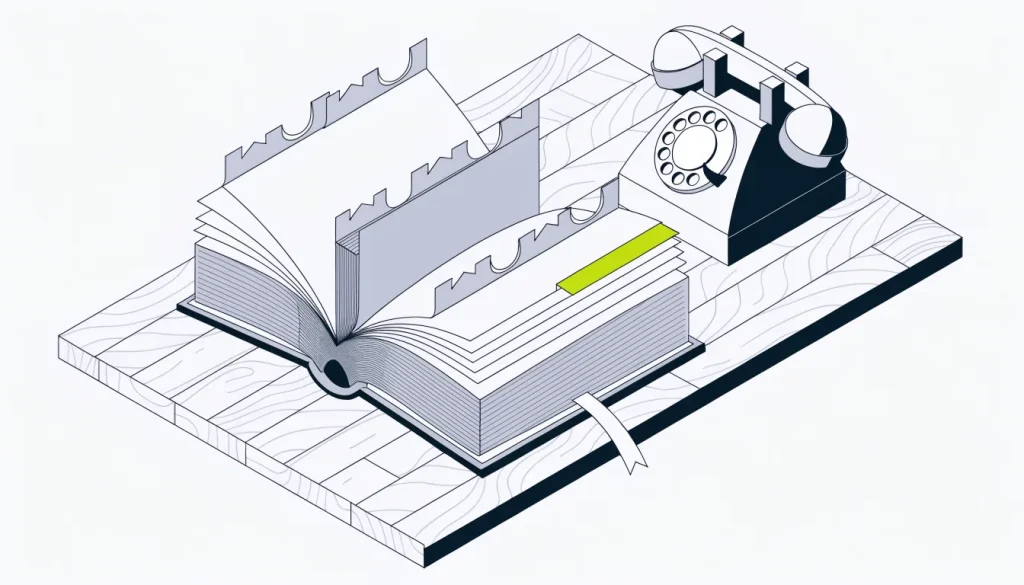
The yellow pages as a category directory
A yellow pages directory is a list of local businesses grouped under category headings, such as lawyers or plumbers. Within each heading, businesses appear in alphabetical order. The publisher earns its money from advertisers, not from the people who read the book.
A business directory, in plain terms, is a published list of companies with their contact details. The yellow pages version adds one idea that made it useful for decades. A reader does not need to know any company name in advance, only the kind of service they want.
The name comes from the color of the paper.
In 1883 a printer in Cheyenne, Wyoming ran out of white paper and printed a directory on yellow stock. Reuben H. Donnelley then produced the first official Yellow Pages directory, for Chicago, in 1886.
The yellow pages grew out of the telephone directory, which is a book listing the people and firms reachable by phone. The first telephone directory was issued on 21 February 1878 in New Haven, Connecticut. It was a single cardboard sheet listing 50 subscribers.
Today the phrase stretches beyond paper. It also describes websites that keep the same category structure, such as Yellowpages.com. In everyday speech, “the yellow pages” can mean almost any directory of local businesses.
How a directory funded by advertisers operates
A yellow pages directory operates by gathering basic business details, filing each business under a heading, and selling extra visibility to firms that want more attention. The free entry carries a name, address and phone number. Paid space sits around those plain entries and competes for the reader’s eye.
The sorting layer
Headings do the sorting. A heading such as “plumbers” pulls every plumbing firm in the coverage area into one place. The way publishers choose and assign those headings is a topic of its own, covered in the guide to yellow pages categories.
Category placement still matters online. Proper categorization in business directories is listed as a primary factor in local search visibility. A business filed under the wrong heading is hard to find, however accurate its phone number is.
The money layer
Readers never paid for the printed book. Basic listings appeared in small type at no charge. Businesses that wanted to stand out paid for display ads in various sizes.
That split between free entries and paid space is the economic engine of every yellow pages product. The publisher needs a complete list to attract readers. It needs advertisers to pay for printing, delivery and staff.
The shared name
In the U.S., AT&T never registered the “yellow pages” name or the walking-fingers logo. Because of that, many publishers use the name and the logo freely. There has never been one single American Yellow Pages company.
Neighboring directory types
White pages list individuals and businesses alphabetically, with no category headings. The contrast between white and yellow pages gets a fuller treatment in a later part of this series. Grey pages, also called reverse directories, let a user look up subscriber details from a phone number, and they are not available everywhere.
Print books, online sites and data feeds
Yellow pages directories come in three broad forms: printed books, online directory websites, and data feeds that pass listing details to other services. Each form uses the same core record of a business name, address, phone number and category. They differ in who reads them and how entries are arranged.
| Format | How entries are arranged | Typical use |
|---|---|---|
| Printed yellow pages | By category, then alphabetically | Finding a type of local business |
| Printed white pages | Alphabetically by name | Finding a known person or firm |
| Grey pages | By phone number | Learning who holds a number |
| Online yellow pages | By category heading on a website | Searching local listings by service |
| Data aggregator feeds | Supplied in bulk to other publishers | Spreading listing details across sites |
Printed directories
The printed book is the original form. A household received it, kept it near the phone, and opened it at the right heading. Ad options ran from bolded business names up to four-color two-page spreads.
Online directories
Online versions keep the heading structure but let a reader search instead of flipping pages. Yellowpages.com and Whitepages.com launched online in April 1996. How the shift from paper to screens unfolded is the subject of another part of this series.
Yellowpages.com changed hands several times after launch. BellSouth and SBC bought it in late 2004, and it became an AT&T subsidiary in 2006. Today it is operated by Thryv Inc., the name Dex Media adopted in 2019.
Online directories also changed what a small business buys. A firm can buy one listing under a category such as “plumbers” instead of buying many search keywords. That one decision replaces a long list of individual search terms.
Data feeds
A data aggregator, as the term is used here, is a company that collects business details and supplies them to other sites. Business listing data is distributed through traditional Yellow Pages, Yellow Page-style data aggregators and SEO services. A single record can therefore surface in places the business never visited.
What the yellow pages mean for a local business now
For a local business, the yellow pages now matter less as a book and more as a source of listing data. Print use fell sharply, yet online directory entries still carry names, addresses, phone numbers and categories that other services read. An accurate entry protects the business record; an inaccurate one spreads errors.
Print reach has shrunk
By 2011, nearly 70% of Americans said they rarely or never used printed phone directories. Outside the U.S., the UK Yellow Pages went fully digital, with the last print copies delivered on 18 January 2019. A business planning around the printed book is planning around a smaller audience.
Listing data travels
Google says Business Profile information comes partly from third-party licensed data, plus public web content and users. That means details held by directories can feed into what a search engine shows. Where yellow pages data turns up in search is covered in a separate part of this series.
A free entry exists
Thryv says a business can list on Yellow Pages for free by finding its listing, claiming it, and creating a free account. A small-business development center checklist names YellowPages (yp.com) among the free directories worth claiming. The same checklist advises keeping information consistent and correct on each site.
Paid products are optional
YP has sold local search ads, SEO, SEM, display, listing management and web design alongside its print directories. None of those is required to appear in the directory. The guide to yellow pages advertising walks through how those paid options work and what to weigh.
Print delivery is a separate question
Some owners and residents simply want the printed book to stop arriving. Yellowpagesoptout.com, now optoutyp.com, stops print directory delivery only. It says it does not handle other requests, including changes to online listings.
Beliefs about the yellow pages that do not hold up
Several common beliefs about the yellow pages are wrong. The name is not one company’s trademark, the color was not a branding choice, and a business does not have to pay to be listed. Opting out of the printed book also leaves the online listing untouched.
“Yellow Pages is one trademarked company”
In the U.S., the name and the walking-fingers logo are unregistered. Many different publishers have used both. A directory calling itself the yellow pages may have no link to any other directory with that name.
“The yellow color was a marketing decision”
The color was an accident of supply. A Cheyenne printer ran out of white paper in 1883 and used yellow stock instead. The look stuck and became the category’s identity.
“A business has to pay to appear”
Thryv offers a free listing on Yellow Pages. Paid products are layered over that free entry and are optional. A business can be present, accurate and findable without buying anything.
“Stopping the printed book removes the online entry”
The print opt-out site covers print delivery only. An online listing stays live after a household or business opts out of the book. Changing the online entry is a separate task handled through the directory itself.
“Directory listings only matter to people flipping pages”
Directory records also travel as data. Listing details pass through data aggregators and SEO services, and Google uses licensed third-party data for Business Profiles. A directory entry can shape what appears elsewhere, even if few people read the directory directly.
Frequently asked questions
What are the Yellow Pages used for?
The Yellow Pages are used to find a local business by the type of service it offers. A reader looks under a category heading, such as lawyers or plumbers, and compares the firms listed there. Online versions do the same job through a searchable website.
What is the meaning of “yellow pages”?
“Yellow pages” means a business directory organized by category and funded by advertising. The name comes from a Cheyenne, Wyoming printer who ran out of white paper in 1883 and printed on yellow stock. The term now also covers online business directories.
Can you look people up in the Yellow Pages?
The Yellow Pages list businesses, not private individuals. People traditionally appear in the white pages, which list individuals and businesses alphabetically by name. A yellow pages directory files only businesses, under category headings.
How do I search a number in yellow pages?
A standard yellow pages directory is sorted by category, so it cannot be searched by phone number. Looking up details from a number is the job of grey pages, also called reverse directories. Those are not available everywhere.
Where to read next on this hub
This guide is the starting point for a wider hub on yellow pages directories. Its other guides cover how directory advertising is sold and how a single business listing behaves.
The series parts go deeper on categories, print history and search data. For the full set of topics in one place, start from Yellow Pages explained and follow whichever thread matches the decision in front of you.